
By L.A. Loss & Abortion Doula
“Once the baby comes, he’ll settle down.”
“He wants a child, so he must be serious about you.”
“Having a family will bring you closer.”
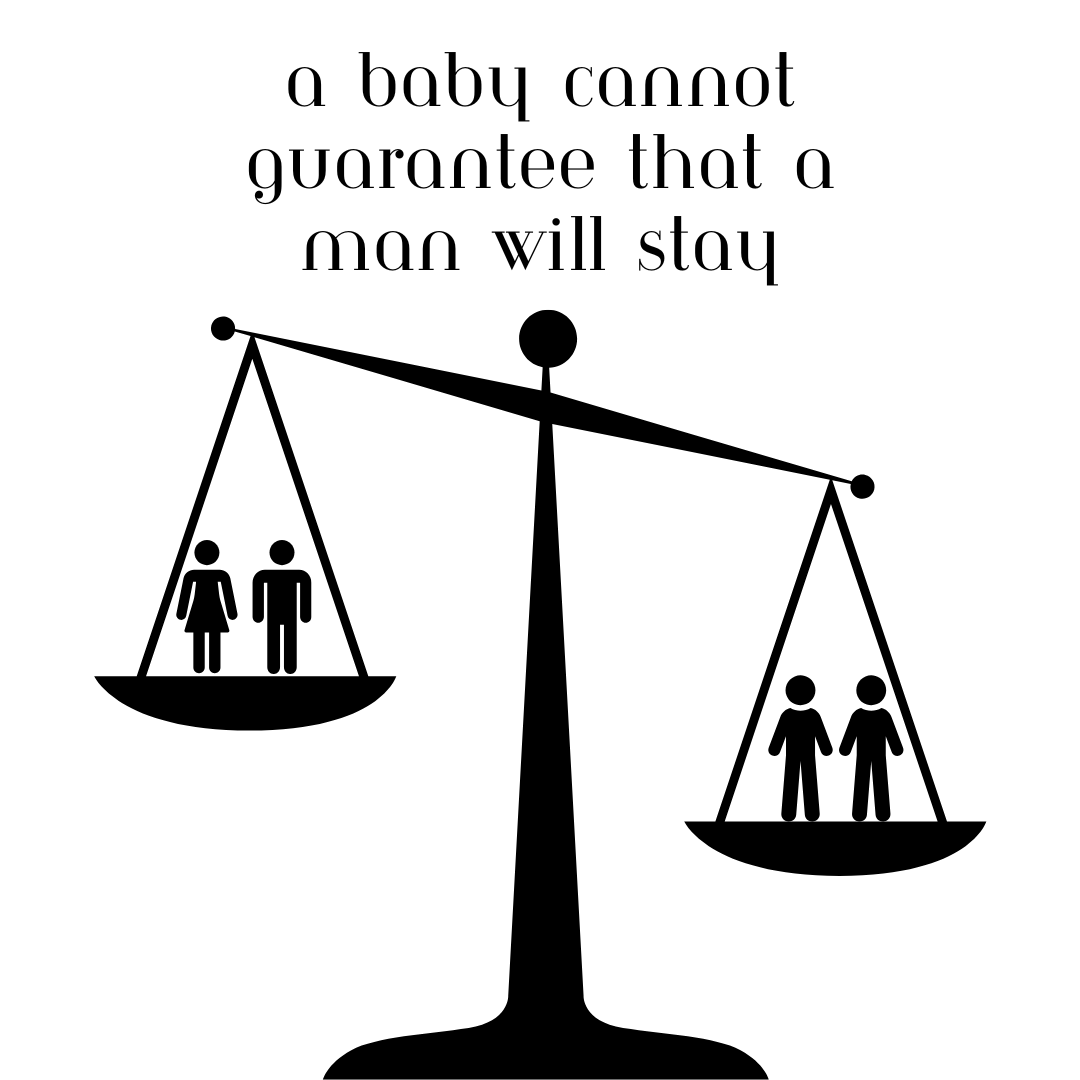
These statements offer reassurance, but they promise something pregnancy cannot guarantee: a man’s commitment.
A man can want a baby without being prepared to maintain a relationship. He can be excited about becoming a father without having demonstrated the patience, consistency, and responsibility that raising a child requires. Wanting a child and being a dependable partner are separate things.
Whether it is a situationship, friendship, dating, an engagement, or a marriage, having his baby is no guarantee he will stay. The statistics discussed below concern marriages, but the practical message applies at every stage: pregnancy cannot secure a man’s commitment.
Why I Am Using Statistics From the Netherlands
For this comparison, I am using Netherlands statistics because I could not identify a reliable nationwide U.S. dataset providing directly comparable divorce percentages for male–male, male–female, and female–female marriages over the same follow-up period.
One limitation of the U.S. Census Bureau’s American Community Survey is that it asks about recent divorces without recording the former spouse’s sex. Those responses therefore cannot reliably separate divorces into these three marriage types.
These are Dutch findings, not American divorce rates, and they should not be assumed to describe U.S. marriages.
What the Marriage Statistics Show
Statistics Netherlands followed couples who married in 2015 and recorded the percentage who had divorced by January 1, 2025.
| Marriage type | Percentage divorced |
|---|---|
| Two men | 12.9% |
| A man and a woman | 13.3% |
| Two women | 24.2% |
Marriages between two men had the lowest divorce percentage in this group, with marriages between a man and a woman close behind. Marriages between two women had the highest. These figures measure divorce, rather than every separation or relationship breakup.
Giving Birth Is Not What Guarantees His Commitment
Based on these Dutch figures, men married to men had a higher rate of avoiding divorce than men married to women—without either spouse needing to give birth to keep the marriage together. Having his baby is no guarantee he will stay.
Two men cannot conceive a child using only their own sperm, although they can become parents through surrogacy, adoption, or previous relationships. Men can maintain lasting partnerships without their partner carrying their child.
The difference between divorce percentages for marriages between two men and marriages between a man and a woman was 0.4 percentage points. These records do not establish anyone’s reproductive capacity, identify which couples were parents, or explain why marriages ended. They cannot show that an inability to give birth causes greater commitment.
But they challenge the assumption that a woman needs to bear a man’s child to build a lasting relationship with him. A woman’s ability to carry his child is not a guarantee of his commitment.
Fatherhood Is Not a Promise of Partnership
When a man says, “I want you to have my baby,” a woman deserves to understand what he is offering beyond that sentence.
Does he want the daily work of parenting? Has he discussed how expenses, child care, household responsibilities, and employment would work? Does he follow through on commitments now? Can he handle disagreement without disappearing, threatening to leave, or withdrawing support?
These questions do not predict the future perfectly. They help move the conversation from an imagined family to the responsibilities of an actual one.
A pregnancy announcement is a moment. Parenting is an ongoing responsibility.
A Child Cannot Do the Work of Repairing a Relationship
A baby cannot resolve dishonesty, establish trust, or make an unwilling man participate.
Couples may grow closer through parenthood. But hoping that a baby will repair an unstable relationship places an enormous expectation on a child who has no control over either adult’s behavior.
A woman deserves commitment expressed through consistent actions. She should not have to become pregnant to find out whether a man intends to offer it.
And if a man leaves, his decision is not evidence that she failed to be loving enough, patient enough, or deserving enough. His choices remain his responsibility.
American Families Also Show That Parenthood Does Not Guarantee Staying Together
U.S. Census data provide evidence more directly relevant to parenthood: in 2022, approximately one in four children under 21 lived with one parent while their other parent lived outside the household.
That does not mean every parent living elsewhere abandoned a child. It does not establish who ended a relationship, and living separately does not necessarily mean a father is uninvolved.
It does show that having a child together is no guarantee that parents will continue living together.
Consider Motherhood Beyond His Promise to Stay
For a woman considering pregnancy, one difficult question deserves room:
Would I still want to become a mother under circumstances where this relationship ends?
That question does not assume abandonment. It acknowledges that no relationship comes with a lifetime guarantee.
It also creates space to consider what support would actually be available: trusted relatives or friends, dependable child care, income, housing, and a realistic division of parenting responsibilities.
A father remains responsible for his child even when the romantic relationship ends. Whether he fulfills that responsibility is a separate question from whether he stays with the child’s mother.
Your Future Deserves More Than Reassurance
Women can want children deeply and still decide that a particular relationship or moment is not right for motherhood. Women can also choose motherhood while recognizing that a partnership may not last.
The decision deserves honesty about what is known, what is promised, and what remains uncertain.
A baby has needs of their own. A baby cannot guarantee a wedding, fidelity, financial support, or a lasting relationship.
At every stage—situationship, friendship, dating, engaged, or married—choose motherhood because you want to raise a child, not because someone has promised that a child will keep a man.
Sources
- Statistics Netherlands: 25 Years Since First Same-Sex Marriages in the Netherlands, March 2026.
- UCLA Williams Institute: The Economic Impact of Marriage Equality 10 Years After Obergefell, June 2025. Explains the American Community Survey’s limitations for identifying same-sex divorces.
- U.S. Census Bureau: Custodial Parents and Their Child Support, 2022, August 2025.
Leave a Reply